Showing posts with label Parkinson's. Show all posts

Saturday, May 23, 2015

Loving Bodies

Yes. it is beautiful. But not exclusively important,
and that's what took me a regrettably long time to learn.


It has long been an interest of both feminism and religious groups to foster an understanding of human worth that's not just skin-deep.

As a 20th-21st century woman, I consistently learned from guardians, mentors, and no small amount of media (or counter-media) that I should find a mate who would love me not only for my body but also for my mind.

This, I think, has been a good thing. But even good things have their limits.

Part of me may have always known this, but I really began to think about such standards for love in earnest a few years ago when my grandfather was dying.

He had Parkinson's disease, and by the last years of his life the capabilities of both his body and his mind were irreparably diminished. He was a strong, smart man who eventually could not recognize his loved ones or find his way home or feed himself.

It was not a love for his mind (what it was then or what it once had been) that made my grandmother and the rest of my family continue to care for him until his final moments.

This tangible caring may have stemmed from emotional connection, but they understood what we understand when we care deeply for any human being. They tended to him and gave him every dignity they could. Not just because he had done the same for his parents and children, or because he was once a hardworking and self-sufficient intellectual. They did it because they knew and loved a human being, regardless of circumstance.

When I experienced grief and depression around that same time, my partner and friends and family loved me not because they were in love with my mind (as it was then or what it once had been), but because they loved me, the whole me, no matter what changes I faced, and they were determined to show me that as best as they could.

(Circumstances never define the human being we love, just the ways in which we might show love to them.)

And that's when I knew how beautiful it could be to love a body.

So I'm not willing to let measures of beauty - even ostensibly honorable measures like in the image above - strip me of any amount of my humanity. And I'm not willing to privilege emotional love and mental love so consistently over physical love, whether that physicality is sex, or snuggling, or caring for someone when they're ill, or massaging someone's aches and pains.

For those who know that I'm demisexual, someone whose attractions depend almost solely on an emotional connection, this anti-hierarchy of love may come as a surprise. But the commitment to owning our own reality and affirming others' realities, whatever they may be, is marvelously compatible with seeing oneself or someone else as a whole person. In fact, many of us on the asexual spectrum appreciate physical acts of love as part of our own everyday reality, and our personal values will vary as much as in any other group.

For those for whom this is not a matter of innate preferences but of spiritual edification, consider what "loving bodies" looks like at its best in your religion. For Christians, even traditional marriage vows have included "to have and to hold" and "in sickness and in health," and remember how consistently that incarnate Jesus fed bodies, washed bodies, healed bodies. If we disembody our partners and our communities, we risk losing significant portions of what it means to be people of faith in relationship.

I'd like to challenge anyone wrestling with the merits of physical love to take note of it when you see it over the next few days. It could well be platonic or familial or neighborly, but notice some tangible interaction of profound caring between two or more fleshy humans. Notice how some acts are inextricably interwoven with mind and emotion, and how some are the embodiment of love in their own right.

Will you love some-body?

Saturday, February 18, 2012

Letter to Grandpa

I offered the following letter as the eulogy at my grandfather's funeral this week. Grandpa just recently celebrated his 91st birthday and lived with my parents and grandmother for the past two years. His health and strength, both cognitive and physical, deteriorated gradually due to Parkinson's Disease, and he received home hospice care for the past 10 months. (I wrote about him here in October 2010 as well.)

This gradual process was painful for him and for all of us. Indeed, it raised many theological questions for me. And while I still do not have all of the answers (nor do I expect to), I do believe I have been given the most important one. The one about identity - who we really are; why we love and are loved.


Source


Dear Grandpa (my godfather and my "Grandsprout"),

The earliest memory I have of you is walking with you in your vegetable garden in Brooklyn. One time, I found a stick there and you let me bring it home for our dog like some kind of souvenir. (Because I was visiting one of the coolest places I'd ever been, and I had to go out and share a part of it with somebody.)

That's how I feel about the love that you and Nana have shared. That needs to be passed along to everyone. It isn't just your garden variety kind of love. It is tenderly planted, lovingly grown, and devotedly protected. It has deep roots and widespread branches. But the best part is that you were always inviting us to walk in your garden. You and Nana both loved so many friends and family members, too.

You loved us with every bowl of soup and plate of manicotti, every fresh-baked loaf of bread, and every homegrown veggie. You loved us in the way you cared for your parents and your neighbors. You loved us in wanting the best for us, and in reconciling when it was time for reconciliation.

And then there is what I learned through all the people who have been loving you and caring for you. Your wife, your children, our extended family, our church congregation, ministers and chaplains, and our own personal fleet of angels: the caregivers and aides and healthcare professionals who may have pulled up in the driveway as strangers, but came through the door as friends, and left the house as family.

Because love like this means that there are no strangers, only more people to feed. (And we like that.)

As the dementia progressed, it was so difficult to see everything we thought made you "you" slowly begin to slip away - your sharp mind, your memories, your strong sense of self. We loved those things about you. But they weren't why we loved you. And I finally realize that there is a difference.

I believe that we receive grace from God not because of what we do or who we think we are, but because of who God is and what God does. And I believe that we are to love each other like that as best as we can: not because of who we think we are or should be, but because of who God says we are - that we are all meant to love and be loved. Unconditionally. No matter the circumstances.

The last memory I have of you is from Christmas. Nana and Mother and Dad and I were playing Apples to Apples and laughing so hard. And you were laughing with us. The joy we felt in each other's company was palpable.

Grandpa, we miss you now that you have continued on, but you aren't far from our minds or hearts. And I hope the joy that I feel in knowing that you are at peace today is just as palpable as our joy together on Christmas Day.

Love,
Sprout

Friday, January 28, 2011

90 Years (and Outreach Opportunities)

Today is my grandfather's 90th birthday!

In his honor, I am contributing to three very different, very meaningful organizations. I invite anyone who is interested to join us in celebrating Grandpa's birthday and supporting any of the organizations below. Click on their names to visit their websites and learn more about their work. Where appropriate, I've also linked to the pages I've created there.


Parkinson's Disease Foundation - Grandpa has Parkinson's Disease, "a movement disorder that is chronic and progressive, meaning that symptoms continue and worsen over time." Everyday tasks have become difficult for him: walking, moving, standing, sitting, eating, talking. Learn more about PD at the Foundation's website. View our fundraising page here. I've set a goal to raise $100, but there is no minimum or maximum amount requested.


Catholic Diocese of Memphis, Tennessee - Grandpa is my godfather. I often joke that, although I was confirmed United Methodist and raised in different Protestant churches, the fact that my godparents are Roman Catholic may have contributed to my deep desire for Catholic-Protestant kinship. I've decided to support the ministries of the diocese of Memphis in particular because it is the city where my grandparents met. Click here to view the different ministries that are accepting donations. There is no minimum or maximum amount requested.


Heifer International - For years, Grandpa helped to provide food for his family and community, working in his family's business as a butcher and laboring in his own vegetable garden. He bestowed upon me one of my favorite childhood nicknames: Sprout. Heifer International seeks to "work with communities to end hunger and poverty and care for the earth" by empowering communities and fostering self-reliance. Visit "Grandsprout's" registry here. Donations of as little as $1 can be given "Where Most Needed" and the cost of a particular animal/plant or share of an animal is $10+.

Thank you for your time!


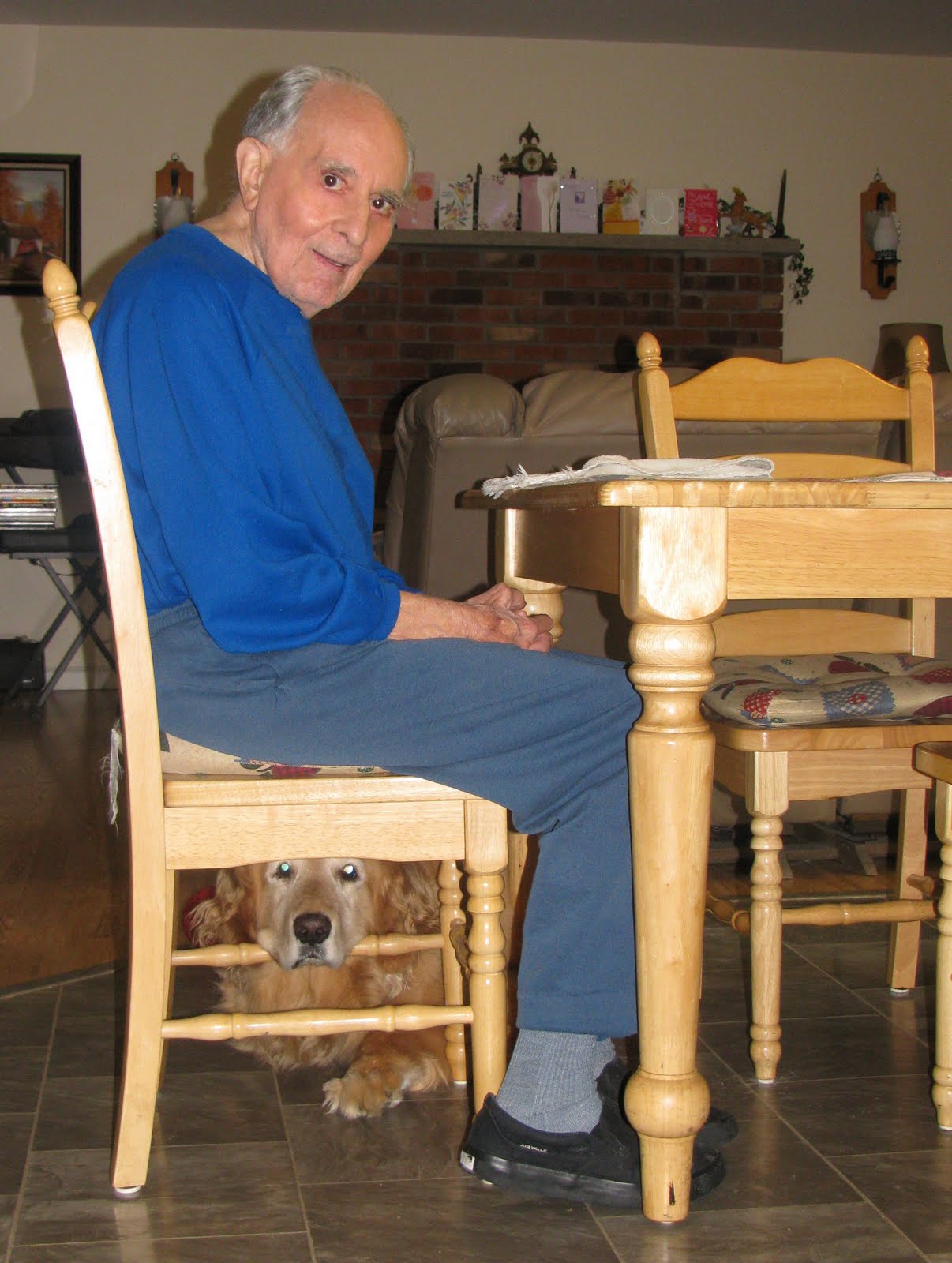
The dog, of course, constantly watches
over Grandpa and is never far away.


May each and every year of your life be blessed, that you may be both protector and protected, healer and healed, lover and loved.

Wednesday, October 20, 2010

Cleaning the Lamp Posts

Grandpa's Wisdom in the Midst of Parkinson's

Last week, while I was home for a few days with my parents and grandparents, my grandfather took a spill. It was only when we had already helped him up that we realized he had a large, bruising bump on his head and required immediate care.

Parkinson's disease makes too many everyday tasks for my grandpa more difficult than they have ever been before: walking, moving, standing, sitting, eating, talking. His hands shake, his limbs are stiff, and his mind seems perpetually clouded. He has always been an exceptionally brilliant man. If everyone has but one thing they personally consider self-identifying, Grandpa's intelligence is his. And he is now often unaware, or dazed, or seemingly incoherent, but frequently he seems frustrated as well, as though he is not only in a haze but confused as to how he got there when he knows - he knows - that he is a bright, strong, competent person.

It's difficult for him to understand us - not that his children or grandchildren have ever really been all that easy to understand - but he finds it difficult to know our intentions, answer questions, and follow conversational threads. It's difficult to understand him, too, though sometimes he makes himself especially clear.

One day this past summer, he stood before me and looked me square in the eye. "Enjoy life," he said, his expressive eyes compensating for the brevity. He doesn't always know who I am, but some things are too important to say no matter who says them and to whom.

This time, as I was icing his bruise, Grandpa told me, complete with its anecdote-esque dialogue tag, "He said, 'Merry Christmas, Nancy.'"

His wife's name. We attributed the rest of the sentence to the fact that my mother and grandmother had just been listening to a CD that I'd compiled for my parents last Christmas, which included a couple of seasonal tunes.

We were fairly sure that Grandpa's difficulty conversing and general quietness were more due to the Parkinson's itself than to the fall, but we needed to be sure that he remained conscious until the EMTs arrived.

"Were you listening to the music?" I asked.

"Of course."

"What's your favorite song, Grandpa?"

"Beef." He threw me for a loop on that one. His expression hadn't changed and it was impossible to gauge whether he was being humorous or serious or had misheard me or had simply chimed in with a nonsequitur.

"Beef?"

"Beef!" More animated this time; not coarse, but strangely energized if just for a moment.

It reminded me of Stone Soup, because we'd recently been talking about that story, so I quoted a line from it about beef and used it as a segue. "Did you like being a butcher?"

"Not particularly." This a conversational tone; honest, not detached, but without great lament or disappointment.

"Well, what's your favorite thing to do?"

"To do?"

"Yeah. In the whole wide world."

"Ah," he said. "Cleaning the lamp posts."

I'm not entirely sure why, but this struck me as significant, poignant.

An unexpected answer, to say the least, though I know Grandpa to be a hard worker who has always valued diligence. A man who, for years, labored lovingly over his own garden in addition to the time and energy he devoted to his business. So the idea of him cleaning lamp posts - even enjoying it - does not radically stun me.

But the imagery did.

Immediately I thought of illuminated paths in the dark, a guiding light in the midst of unfamiliar ground.

I thought of the tall poles that in daylight appear meaningless, or else only aesthetically interesting - shapes and hues of wrought iron suspending a glass encasement in the air. At night, these works of craftmanship may all but disappear in the darkness despite themselves. Certainly their structure and technical mechanisms are integral to their effectiveness, yet sometimes all that can be seen is the light at work.

In a fantastic irony, as a young child my brother used to say that our grandfather made the streetlights come on. I'm not sure where he came up with that tale - surely my parents' twisted influence - but I still think of Grandpa whenever I travel by the glow of streetlights, and especially whenever they first go on for their night shift.

Today I attended a talk during which the ever-inspirational speaker, Dr. Lynne Westfield, mentioned that artists depict us with lightbulbs shining above our heads to signify new ideas, seeing something illuminated in a new way.

My grandfather may occasionally confuse his meats and his music, but to this day, at 89 years of age, he can open my eyes to see life in a new light.


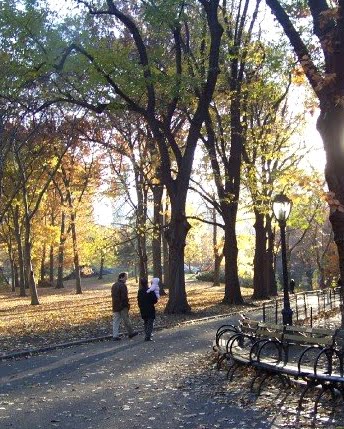
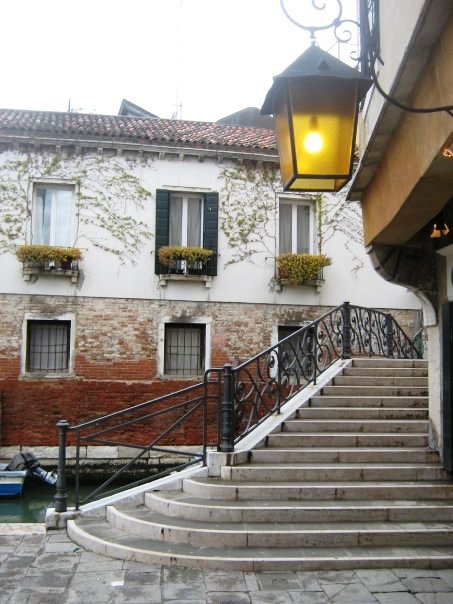
All photos above are my own, taken from 2007-2010. Their locations, in order:

Vienna, Austria. Vassar College, New York. Madison, New Jersey. London, England. Sarah Lawrence College, New York. Arboretum in Hamptonburgh, New York. Central Park, New York. Sarah Lawrence College, New York. Florence, Italy. Nice, France. Venice, Italy.
Related Posts Plugin for WordPress, Blogger...