Showing posts with label Family. Show all posts

Saturday, May 23, 2015

Loving Bodies

Yes. it is beautiful. But not exclusively important,
and that's what took me a regrettably long time to learn.


It has long been an interest of both feminism and religious groups to foster an understanding of human worth that's not just skin-deep.

As a 20th-21st century woman, I consistently learned from guardians, mentors, and no small amount of media (or counter-media) that I should find a mate who would love me not only for my body but also for my mind.

This, I think, has been a good thing. But even good things have their limits.

Part of me may have always known this, but I really began to think about such standards for love in earnest a few years ago when my grandfather was dying.

He had Parkinson's disease, and by the last years of his life the capabilities of both his body and his mind were irreparably diminished. He was a strong, smart man who eventually could not recognize his loved ones or find his way home or feed himself.

It was not a love for his mind (what it was then or what it once had been) that made my grandmother and the rest of my family continue to care for him until his final moments.

This tangible caring may have stemmed from emotional connection, but they understood what we understand when we care deeply for any human being. They tended to him and gave him every dignity they could. Not just because he had done the same for his parents and children, or because he was once a hardworking and self-sufficient intellectual. They did it because they knew and loved a human being, regardless of circumstance.

When I experienced grief and depression around that same time, my partner and friends and family loved me not because they were in love with my mind (as it was then or what it once had been), but because they loved me, the whole me, no matter what changes I faced, and they were determined to show me that as best as they could.

(Circumstances never define the human being we love, just the ways in which we might show love to them.)

And that's when I knew how beautiful it could be to love a body.

So I'm not willing to let measures of beauty - even ostensibly honorable measures like in the image above - strip me of any amount of my humanity. And I'm not willing to privilege emotional love and mental love so consistently over physical love, whether that physicality is sex, or snuggling, or caring for someone when they're ill, or massaging someone's aches and pains.

For those who know that I'm demisexual, someone whose attractions depend almost solely on an emotional connection, this anti-hierarchy of love may come as a surprise. But the commitment to owning our own reality and affirming others' realities, whatever they may be, is marvelously compatible with seeing oneself or someone else as a whole person. In fact, many of us on the asexual spectrum appreciate physical acts of love as part of our own everyday reality, and our personal values will vary as much as in any other group.

For those for whom this is not a matter of innate preferences but of spiritual edification, consider what "loving bodies" looks like at its best in your religion. For Christians, even traditional marriage vows have included "to have and to hold" and "in sickness and in health," and remember how consistently that incarnate Jesus fed bodies, washed bodies, healed bodies. If we disembody our partners and our communities, we risk losing significant portions of what it means to be people of faith in relationship.

I'd like to challenge anyone wrestling with the merits of physical love to take note of it when you see it over the next few days. It could well be platonic or familial or neighborly, but notice some tangible interaction of profound caring between two or more fleshy humans. Notice how some acts are inextricably interwoven with mind and emotion, and how some are the embodiment of love in their own right.

Will you love some-body?

Tuesday, May 20, 2014

Breaking Ground

I had a realization of my own after the goodbye-themed inter-generational Bible study I led at church the other night.

In a time of lifting up loved ones who have passed on or moved away, I named my grandfather (my eulogy for him is posted here), and I explained that I called him Grandsprout because he called me Sprout.

What I've realized since Sunday night is that no one else in the world calls me Sprout and what that means. When my grandfather's dementia deepened to the point of no longer recognizing his loved ones, we ourselves struggled to hold on to who we were to him. When he died, the me who was Sprout died, too.

It was not only the loss of a beloved person but also the end of a relationship, of all the relationships he had with his family and friends.

And at the heart of our relationship, his and mine, was growth. A love of greenery and soil and earthy things. A wisdom of seasons and perseverance and devoted care. My grandfather watched me grow up, and I watched my grandfather grow his garden. These were the joys we basked in together.

So it's only fitting that, when I finally found the language to heal myself almost two years later, it came to me in the form of plant life. Specifically, it came to me in an image that my professor, Angella Son, included in her new book, Spirituality of Joy. Although it took on a different meaning for me than it did for her, the image of the moso bamboo tree inspired me to compose a song.

The lyrics are a conversation between a soul and God, throughout the sort of experience that is often known in spiritual circles as the dark night of the soul. But in this case, the process is likened to the growth pattern of the moso bamboo tree, which grows roots for five years before it even breaks ground (and then it hits some kind of plant puberty and grows about 90 feet in six months, but who's counting?). To the unsuspecting gardener, those first five years look to be a failure, like nothing good is happening and any hope of vegetation is gone.

But the God I've come to know through my grief is a God with dirty fingernails and all the time in the world. A God who knows the strength of roots and the goodness of brokenness when a seed is breaking open, breaking ground.

It's through writing this song that I began to live again, and it's only now that I realize that the person I came to be, in some way, is still and always will be my Grandsprout's Sprout.


Growing Underground
Music and lyrics by Kimberley Fais, 2013

You plant. You feed. You water. I sleep.
Then I stretch, and I breathe, and take root in the deep.
Even though I can't see, You promise me
I'm not going under. I'm just growing underground.
And I will grow out before I grow up.
It's a long way out.

You've got time in Your hands and dirt in Your nails.
You see what succeeds when everything fails.
It's hard to believe what You promised me.
I'm not going under. I'm just growing underground.
And I will grow out before I grow up.
It's a long way up.

Deep and dark down here, where I weep with joy,
I'm not drowning out Your still small voice.
Little do I know I'm right where I should be.
I'm where You're tending me.

You planted. You fed. You watered. I woke.
Then I stretched, and I breathed, and through the ground I broke.
And I rose, and I grew. You said: "I promised you--
You were never going under. You were just growing underground.
And I watched you grow the roots that would let you grow up.
Look at you now. . . ."

Monday, June 10, 2013

A Litany for Father's Day

I wrote this litany as part of a worship service with a United Methodist congregation on June 16, 2013.

It is loosely inspired by a litany for Mother's Day by Amy Young over at The Messy Middle. Her litany is called The Wide Spectrum of Mothering and included in her "open letter to pastors (a non-mom speaks about Mother's Day)" - which is a great post in and of itself. Click here to check it out.


One: To those who have welcomed a child into your hearts and homes—
All: We celebrate with you.

One: To those who long to be fathers, but who have no children of your own—
All: We long with you.

One: To those who are expectant fathers—
All: We anticipate with you.

One: To those whose fathers are ill in body, mind, or spirit—
All: We sit with you.

One: To those who have lost your fathers or who never got to know your fathers—
All: We grieve with you.

One: And to those who have fathered us by giving us life or teaching us to live—
All: We honor you.

Thursday, January 31, 2013

Little Talks


'Cause though the truth may vary,
this ship will carry our bodies safe to shore.

-Of Monsters and Men


Evangelism is active listening. It is not colonialism. It is not sharing my faith. It is hearing the God-story unfold in another person's life. That's what I'm learning this semester in my required-for-the-ordination-that-I-may-or-may-not-pursue-someday Evangelism course.

Active listening, no matter how active, can sneak up on you when you least expect it.

Today, as I prepared to leave work (of the nannying variety), I talked to my employer and a colleague of hers.

"This is so funny," the colleague said, as our conversation came to a close. "In the car on the way over here this morning, I was just thinking, 'I don't know if I believe in God anymore.' And now here I am, telling you about all this."

I can't blame this one squarely on occupational hazard; our chat had been just about as far as can be from the topic of God.

But one bit of conversation had led to another, and before long, the colleague recounted for us some stories about her sister who died of cancer some time ago.

The two sisters were extraordinarily linked. Numbers Eight and Nine of nine children in the family, they were raised more like twins. They shared so much - everything from sleeping spaces to daily routines.

Our storyteller described a time that she went on vacation as a young adult. While there, she had an inexplicable urge to buy her sister a pair of socks with a silly design to them. As she and her husband wandered the store, she mused frequently about how the socks reminded her of her sister. Her husband teased her for this sudden obsession with socks - the sort of gift that she had never given to her sister before - but never tried to talk her out of the strange souvenir.

Then, when they reached the cash register, she set them aside. Her husband was shocked that, after all that, she wasn't buying them.

When they returned from the trip, her family had difficult news that they hadn't wanted to share across the distance. Her sister, Kathy, had survived a car accident but had lost both of her feet. Both of her legs had been amputated just below the knees.

The same night that Kathy had been through hours of surgery, her sister, still away and unaware, did not sleep at all. This was strange to her at the time - so uncharacteristic of her. She liked to think she could sleep on a picket fence if need be. But as Kathy struggled through the accident and the aftermath, her sister kept vigil for her without even knowing it.

It was years later that Kathy was diagnosed with cancer, which eventually took her life. One day, as her sister was driving home, she thought again of her twin-soul. She didn't know whether or not Kathy had believed in God, or whether or not that should matter in what awaited her spirit, or whether or not Kathy was at peace. It bothered her - the not-knowing.

It was then that she came to a traffic light and stopped. She glanced to the side and saw a shipyard that she often saw while on this drive, many times before and many times after this day. But this was the one and only day that she saw a particular boat's name scrawled in paint along its stern:

Kathy's Fine

She is.

Saturday, February 18, 2012

Letter to Grandpa

I offered the following letter as the eulogy at my grandfather's funeral this week. Grandpa just recently celebrated his 91st birthday and lived with my parents and grandmother for the past two years. His health and strength, both cognitive and physical, deteriorated gradually due to Parkinson's Disease, and he received home hospice care for the past 10 months. (I wrote about him here in October 2010 as well.)

This gradual process was painful for him and for all of us. Indeed, it raised many theological questions for me. And while I still do not have all of the answers (nor do I expect to), I do believe I have been given the most important one. The one about identity - who we really are; why we love and are loved.


Source


Dear Grandpa (my godfather and my "Grandsprout"),

The earliest memory I have of you is walking with you in your vegetable garden in Brooklyn. One time, I found a stick there and you let me bring it home for our dog like some kind of souvenir. (Because I was visiting one of the coolest places I'd ever been, and I had to go out and share a part of it with somebody.)

That's how I feel about the love that you and Nana have shared. That needs to be passed along to everyone. It isn't just your garden variety kind of love. It is tenderly planted, lovingly grown, and devotedly protected. It has deep roots and widespread branches. But the best part is that you were always inviting us to walk in your garden. You and Nana both loved so many friends and family members, too.

You loved us with every bowl of soup and plate of manicotti, every fresh-baked loaf of bread, and every homegrown veggie. You loved us in the way you cared for your parents and your neighbors. You loved us in wanting the best for us, and in reconciling when it was time for reconciliation.

And then there is what I learned through all the people who have been loving you and caring for you. Your wife, your children, our extended family, our church congregation, ministers and chaplains, and our own personal fleet of angels: the caregivers and aides and healthcare professionals who may have pulled up in the driveway as strangers, but came through the door as friends, and left the house as family.

Because love like this means that there are no strangers, only more people to feed. (And we like that.)

As the dementia progressed, it was so difficult to see everything we thought made you "you" slowly begin to slip away - your sharp mind, your memories, your strong sense of self. We loved those things about you. But they weren't why we loved you. And I finally realize that there is a difference.

I believe that we receive grace from God not because of what we do or who we think we are, but because of who God is and what God does. And I believe that we are to love each other like that as best as we can: not because of who we think we are or should be, but because of who God says we are - that we are all meant to love and be loved. Unconditionally. No matter the circumstances.

The last memory I have of you is from Christmas. Nana and Mother and Dad and I were playing Apples to Apples and laughing so hard. And you were laughing with us. The joy we felt in each other's company was palpable.

Grandpa, we miss you now that you have continued on, but you aren't far from our minds or hearts. And I hope the joy that I feel in knowing that you are at peace today is just as palpable as our joy together on Christmas Day.

Love,
Sprout

Tuesday, December 20, 2011

The Santa Claus Quandary


The first fight I ever remember having with a friend was a not-so-philosophical debate regarding the dubious existence of the man, the myth, the legend: Santa Claus.

It was my best friend, and at five, that was a considerable portion of my world.

But the other sizeable portion, of course, was my family. And my family had told me that Santa was real, and in all my years of barely cognizant life I had never known them to lie to me, so I believed them.

Then one day I came home from kindergarten with this dramatic story about the argument with my friend and how I had defended our family honor. My older brother couldn't bear for me to lose a friend over the dude in the red suit, and promptly took me to the closet in my parents' room to show me the gifts that would have been from Santa that year.

My parents might have been able to convince me, even then, that it was their own stash and, Yes, Virginia, there is a Santa Claus, but they agreed with my brother - it wasn't worth the loss of a friendship, and it was time for The Talk.

The thing is, my mother - being a bit flowery with words and charmingly poetic in her perceptions of all matters of life - still believed in Santa Claus. At least, she said, Santa Claus' spirit was real.

I find it pertinent at this point to note that, future theologian or not, as a child I thought Santa Claus was like God's brother from another mother. I mean, I think I had a good idea about what was in Jesus' job description, but who was God to me at that point?

He sees you when you're sleeping; he knows when you're awake. He knows if you've been bad or good, so be good for goodness' sake!

Sure, God was more powerful (all year long!) and less materialistically affectionate than Santa seemed to be, but it was difficult to differentiate them enough to understand why my spiritually-inclined mother would explain to me that one exists (sometimes as Spirit) and the other does not exist (except in spirit).

As most "emerging adults" evaluate decisions their parents made in order to form their own parenting philosophies, I have since wondered: if I ever were to have children, would I tell them that Santa Claus is real - in spirit or otherwise? For the most part, I believed that I wouldn't.

Sometimes religious families don't share the Santa story because they consider it a "secular" tradition or because it seems to teach - eventually - disbelief, especially disbelief in a seemingly omnipotent, benevolent being basically hailed as Divine around some Christmas trees.

Despite my own initial difficulty separating out the "characters" of God and Santa Claus, this ultimately was not a major problem. Atheists and cultural theists may not entirely understand what I mean when I say this, but by the time I had a personal experience of what I understood to be God, the difference was abundantly clear: Claus could feasibly still exist in whatever form people please, but I can't attest to that so long as I have no experience or reason to affirm it for me. Sort of the way I don't blame atheists for not seeing sufficient evidence for God. I think it would be worse for someone to lie about what they believe or don't believe than not to get the facts straight, whatever they may be. The reasons I have for a belief in God are sufficient evidence for me, and to be the most authentic person I can be, I can only attest to what I believe to be true as genuinely as I can.

Thus the concern I have is not that a child would equate Santa and God, or that their inevitable Santa-crushing moment may shake their faith. I believe in a God who is revealed and made known in various ways, and I believe that faith-shaking moments too often lead to spiritual growth to want to ward them off entirely.

Rather, my concern is simply this: I don't know that I can tell my child that I believe something I don't. It may be a fanciful, wonderful story; the spirit of giving may be alive and well indeed; but Santa Claus as he has come to be known and shared throughout the ages is not a tradition in which I'm that sentimentally invested.

I suppose I could imagine telling stories about Saint Nick, and presenting it that way, or even simply asking children what they think and letting them go through a natural progression.

Last year I saw the Finish film called "Christmas Story" about the orphaned Nikolas, who begins delivering toys to the children of the families who have taken him in year after year, and finally to children throughout the locale. I enjoyed it in its entirety, except for the ending, at which point (SPOILER ALERT) jolly old Saint Nikolas flies off into the moonlight on his inexplicably airborne reindeer-drawn sleigh, waving and winking and whooping out Macy*s Santa belly-laughs. And I know it was obligatory - any kid-friendly film can't risk spoiling the Santa industry for a young viewer. But it would have been such a beautiful movie even without it, and I sort of wish they had let it be.

In spite of all of this, or perhaps in light of it, I admit I've been pondering this quandary from the other end of the spectrum lately. Why? Because I read this piece online and, besides my own mother's more in-depth explanations to me about why she became a firm Santa-espouser, it is perhaps the most beautiful pro-Santa 'argument' I've ever come across. Having read this letter from a mother to her child who demanded the truth, I might consider changing my own stance on what I would tell my hypothetical, nonexistent offspring - and when, and how.

Click here to give it a read. It really is rather beautiful, and it would make my Mama weep with happy Santa-spirit warm-and-fuzzies.

Friday, January 28, 2011

90 Years (and Outreach Opportunities)

Today is my grandfather's 90th birthday!

In his honor, I am contributing to three very different, very meaningful organizations. I invite anyone who is interested to join us in celebrating Grandpa's birthday and supporting any of the organizations below. Click on their names to visit their websites and learn more about their work. Where appropriate, I've also linked to the pages I've created there.


Parkinson's Disease Foundation - Grandpa has Parkinson's Disease, "a movement disorder that is chronic and progressive, meaning that symptoms continue and worsen over time." Everyday tasks have become difficult for him: walking, moving, standing, sitting, eating, talking. Learn more about PD at the Foundation's website. View our fundraising page here. I've set a goal to raise $100, but there is no minimum or maximum amount requested.


Catholic Diocese of Memphis, Tennessee - Grandpa is my godfather. I often joke that, although I was confirmed United Methodist and raised in different Protestant churches, the fact that my godparents are Roman Catholic may have contributed to my deep desire for Catholic-Protestant kinship. I've decided to support the ministries of the diocese of Memphis in particular because it is the city where my grandparents met. Click here to view the different ministries that are accepting donations. There is no minimum or maximum amount requested.


Heifer International - For years, Grandpa helped to provide food for his family and community, working in his family's business as a butcher and laboring in his own vegetable garden. He bestowed upon me one of my favorite childhood nicknames: Sprout. Heifer International seeks to "work with communities to end hunger and poverty and care for the earth" by empowering communities and fostering self-reliance. Visit "Grandsprout's" registry here. Donations of as little as $1 can be given "Where Most Needed" and the cost of a particular animal/plant or share of an animal is $10+.

Thank you for your time!


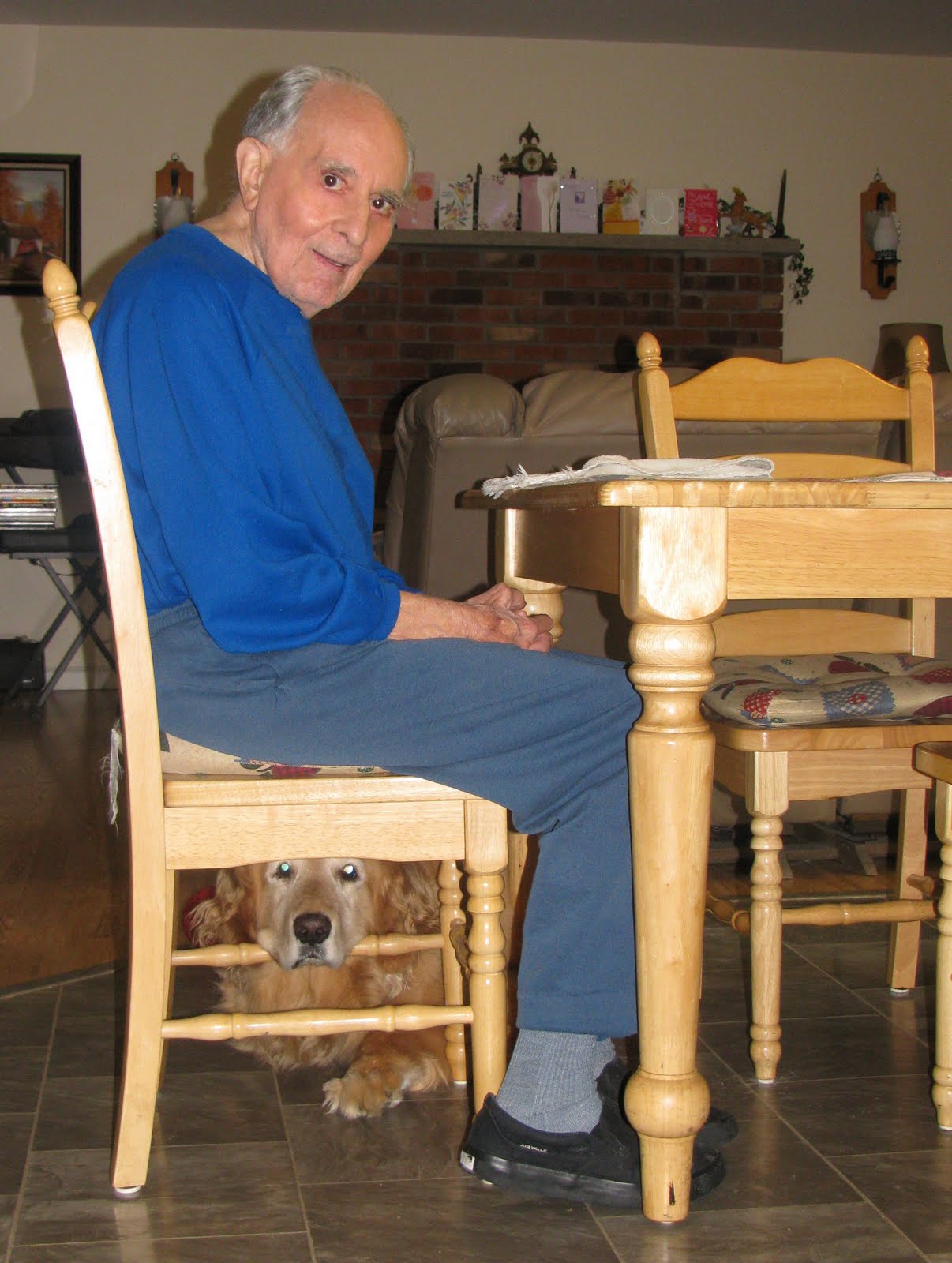
The dog, of course, constantly watches
over Grandpa and is never far away.


May each and every year of your life be blessed, that you may be both protector and protected, healer and healed, lover and loved.

Friday, December 31, 2010

New Year's Challenge

This new year, take on a challenge and give it your all...


...even if it seems bigger than you are.

Tuesday, November 9, 2010

Sex Selection: No More Disappointments

Earlier in the semester in our Religion and the Social Process class, we discussed sexism, in the midst of which I came across this controversial article from The Guardian (UK), April 2010.

Although the procedure is limited to only certain countries, including the U.S., parents have the (expensive) ability to choose the sex of a future child. Interestingly, there is no remarkable sexist split, that one is preferred more frequently to another, as may be expected for any fathomable reason (for instance, because boys traditionally carry on a family name). Boys and girls are 'requested' at similar rates.


Reasons people choose such a procedure are varied: from preventing passing on an illness in the couple's genetics that is sex-specific, to already having had one or more children of one sex and wanting one of a different sex - guaranteed on the next try.


One mother with sons was "tired" of walking down a street and seeing pink dresses in windows and knowing that she didn't have a daughter to wear them. Would her maternal urges have been satiated were her sons to decide that they preferred to wear pink dresses as opposed to the presumably non-pink, non-dressy clothing that they had been given as growing boys?

If the twin girls she had due to this procedure eventually grew "tired" of tea parties and dress-up - perhaps beginnning to imitate their brothers or do other activities not widely considered "feminine," would Mom feel like it had been a wasted effort? Would she be simply content that she got to buy a few pink dresses while the girls were toddlers?

Would she learn to love her daughters as the individual beings they are, regardless of what they wear?

Regardless of the fact that they are female?


I realize it is perhaps unjust for me to raise even hypothetical questions in this accusatory light, and I intend these families no harm. But it hurts me as a daughter to think that my parents might love me because they already had a son, or because I allowed them to have one of each. It hurts to think not only that, if my parents had preferred one sex or the other, I could have disappointed them in my very birth, but also that we live in a world in which people aim to evade disappointment rather than overcome it. It hurts to imagine this as the foundation of any child's life.

Because I was born both a girl and seven years after my brother, neither of which I could control, my parents placed us in the two bedrooms of our old apartment while they slept on a pull-out couch. When I think of that time, I think most about the sacrifices that our parents made just for the sake of our privacy, a right that everyone does not even have, let alone as children. I'm sure it crossed their minds at some point that it would have been convenient in at least that circumstance to have had two children of the same sex and perhaps closer in age, but I also like to think that it did not make them regret having the son and daughter that they had.

I'm sure one of the aforementioned article's points of greatest impact is the stunning advances we're seeing in medicine, and not only the impact on personal health but the effect on autonomy.

But autonomy means you have a choice, and I think there's a far greater one implied than determining the sex of one's child. From my perspective, these are the questions that we face in light of sex-selection:

What are we communicating to children (and to others) about the relationship between parent and child?

What notion of the relationship between parent and child have we come to believe?

Are children accessories? Can we tailor them to our liking? Can we coordinate them with our lifestyles, our decor, our pets?


Are children singularly a parent's life decision?


Or do we acknowledge the impact that every child, every person has on countless people every day?

Do we acknowledge that each one of us is a part of a greater community, and not only an isolated being in a family?

Are children to be constructed to our liking, or do they serve some other purpose beyond satisfying parental instincts?


Of course, I understand the complexity of this entire issue extends far beyond all of this, so let me be clear:

I am not speaking to the classist privilege inherent to sex-selection.

I am not speaking to the selection made to spare a child a potential ailment.

I am not speaking to the debate as to whether this is all an example of humans "playing God."

I am not speaking to the extent that God might be involved in these parental longings and scientific procedures, or whether or not it is indeed God's will that Mr. and Mrs. Jonesing go out of their way to ensure the biological sex of their baby.

Each of these topics could fill a post in its own right.

Yet I find the fact that this article could declare as its subheading (facetiously or not) "No more disappointments" to be a far more potent and detrimental point. This is the stuff of our conscience and our consciousness, folks. This is not just ("just"?) a debate about elite privilege or universal free will. This is immensely internal.

Supporting sex selection (or any fetal-specifier, for that matter) as a means of parental satisfaction has serious implications for distorting the expression and experience of parental love.

It reshapes the image of humanity that we pass along to the generations for whom such science - and more - will be a reality for the entirety of their lives.

Instead of embracing the individuals entering the world, it tells them, "We constructed you. Don't disappoint us."

Sunday, October 31, 2010

Subtle Message, Profound Love

Lately my father and I are learning how to communicate again, particularly connecting through new interests and a new appreciation of each other's experiences.

He's taken up photography, and now occasionally when we're in the car I find myself reminding him to "stop getting distracted by pretty sunsets!"


But inside, I'm excited to see him so excited about the sweeping colors and fading rays, to see him so aware of it all. The last time we were driving into a gorgeous sunset, the kind fit for heroes, and he whooped and hollered at how fantastic it was.

And then he sort of glanced at me, silent and slightly foreboding, as though to ask why in the heck I, as the only free-handed passenger, hadn't taken out a camera yet. So I did my best to capture what I could. On the highway. At 60 miles per hour. For Dad.

Then there's a strange shift that's been taking place, where I've begun talking to each of my parents - married over 31 years now, God bless 'em - about relationships. I've always had a good rapport with my mother, and ending a conversation between us always proves far greater a challenge than beginning one. But this is the first time I can really say I've been bonding with my father over something more serious than photography, crêpes, and Sleepless in Seattle (all fine in their own right, of course), and I'm really enjoying it.

My respect for my dad and his marriage knows no bounds. And although he doesn't always say it directly, I think he in turn has come to appreciate my boyfriend and our long-term, long-distance relationship.

Thus begins my tale.


Several years ago, before my boyfriend and I were dating, we went trick-or-treating. He was a frightening ghoulish figure who blamed his new appearance on the local water. I was a Serta sheep, i.e. an obsolete counting sheep looking for work. I brought a canister to collect for Unicef, but because I was sporting an "Out of Work" sign, people mistook me for a hobo and my collection had mixed results.

Just the same, the Great Halloween Endeavor of the Benefactor Sheep (long-time friend of Santa and the Easter Beagle) not only raised a little money for a cause, but also left me with a jar and slotted lid.

So I have a sheep bank now.

I've had piggy banks before - namely a plastic one I painted and glittered at a friend's party in elementary school, and a giant Crayola crayon bank. And probably others that I remember less vividly because, let's face it, little competes with a glittered pig and a two-foot crayon.

But I like the sound of a sheep bank, and I've begun saving change in mine.


And I've decided that it's only fitting that it go toward transportation to visit with my boyfriend. Besides being busy with school and work, we're both pennysavers and have gone anywhere between 3 months and one year between visits since the move. But instead of dwelling on the idea that we are putting off a trip, I'd rather have a visual representation of progress toward one. So I've labeled it Florida or Bust.

All that said, I wasn't keeping dollar bills in the jar, figuring I would simply collect change for now and could make up the difference when the time came. But recently, when I dropped a coin in, I did a classic doubletake. Where was that familiar chink of metallic collision? I opened the lid... and laughed.

My father had stopped in that week. There had been all of about a minute that I left him alone in the room, and little did I know that, while he was loudly reading off the titles on my shelf, he was stealthily slipping a few wrinkled dollar bills into my sheep bank.

Sometimes people show their love and support for us in the simplest ways.

One of my favorite quotes is (debatably) attributed to St. Francis of Assisi: "Preach the Gospel always. When necessary, use words." My father is no preacher, but I think in his own way he has already begun to put "Francis'" concept into practice.

Thank you, Dad.

Wednesday, October 20, 2010

Cleaning the Lamp Posts

Grandpa's Wisdom in the Midst of Parkinson's

Last week, while I was home for a few days with my parents and grandparents, my grandfather took a spill. It was only when we had already helped him up that we realized he had a large, bruising bump on his head and required immediate care.

Parkinson's disease makes too many everyday tasks for my grandpa more difficult than they have ever been before: walking, moving, standing, sitting, eating, talking. His hands shake, his limbs are stiff, and his mind seems perpetually clouded. He has always been an exceptionally brilliant man. If everyone has but one thing they personally consider self-identifying, Grandpa's intelligence is his. And he is now often unaware, or dazed, or seemingly incoherent, but frequently he seems frustrated as well, as though he is not only in a haze but confused as to how he got there when he knows - he knows - that he is a bright, strong, competent person.

It's difficult for him to understand us - not that his children or grandchildren have ever really been all that easy to understand - but he finds it difficult to know our intentions, answer questions, and follow conversational threads. It's difficult to understand him, too, though sometimes he makes himself especially clear.

One day this past summer, he stood before me and looked me square in the eye. "Enjoy life," he said, his expressive eyes compensating for the brevity. He doesn't always know who I am, but some things are too important to say no matter who says them and to whom.

This time, as I was icing his bruise, Grandpa told me, complete with its anecdote-esque dialogue tag, "He said, 'Merry Christmas, Nancy.'"

His wife's name. We attributed the rest of the sentence to the fact that my mother and grandmother had just been listening to a CD that I'd compiled for my parents last Christmas, which included a couple of seasonal tunes.

We were fairly sure that Grandpa's difficulty conversing and general quietness were more due to the Parkinson's itself than to the fall, but we needed to be sure that he remained conscious until the EMTs arrived.

"Were you listening to the music?" I asked.

"Of course."

"What's your favorite song, Grandpa?"

"Beef." He threw me for a loop on that one. His expression hadn't changed and it was impossible to gauge whether he was being humorous or serious or had misheard me or had simply chimed in with a nonsequitur.

"Beef?"

"Beef!" More animated this time; not coarse, but strangely energized if just for a moment.

It reminded me of Stone Soup, because we'd recently been talking about that story, so I quoted a line from it about beef and used it as a segue. "Did you like being a butcher?"

"Not particularly." This a conversational tone; honest, not detached, but without great lament or disappointment.

"Well, what's your favorite thing to do?"

"To do?"

"Yeah. In the whole wide world."

"Ah," he said. "Cleaning the lamp posts."

I'm not entirely sure why, but this struck me as significant, poignant.

An unexpected answer, to say the least, though I know Grandpa to be a hard worker who has always valued diligence. A man who, for years, labored lovingly over his own garden in addition to the time and energy he devoted to his business. So the idea of him cleaning lamp posts - even enjoying it - does not radically stun me.

But the imagery did.

Immediately I thought of illuminated paths in the dark, a guiding light in the midst of unfamiliar ground.

I thought of the tall poles that in daylight appear meaningless, or else only aesthetically interesting - shapes and hues of wrought iron suspending a glass encasement in the air. At night, these works of craftmanship may all but disappear in the darkness despite themselves. Certainly their structure and technical mechanisms are integral to their effectiveness, yet sometimes all that can be seen is the light at work.

In a fantastic irony, as a young child my brother used to say that our grandfather made the streetlights come on. I'm not sure where he came up with that tale - surely my parents' twisted influence - but I still think of Grandpa whenever I travel by the glow of streetlights, and especially whenever they first go on for their night shift.

Today I attended a talk during which the ever-inspirational speaker, Dr. Lynne Westfield, mentioned that artists depict us with lightbulbs shining above our heads to signify new ideas, seeing something illuminated in a new way.

My grandfather may occasionally confuse his meats and his music, but to this day, at 89 years of age, he can open my eyes to see life in a new light.


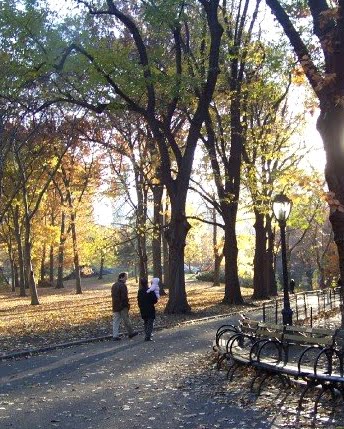
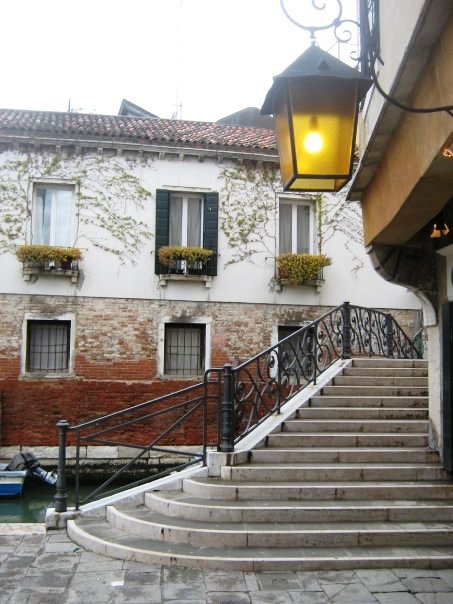
All photos above are my own, taken from 2007-2010. Their locations, in order:

Vienna, Austria. Vassar College, New York. Madison, New Jersey. London, England. Sarah Lawrence College, New York. Arboretum in Hamptonburgh, New York. Central Park, New York. Sarah Lawrence College, New York. Florence, Italy. Nice, France. Venice, Italy.
Related Posts Plugin for WordPress, Blogger...